
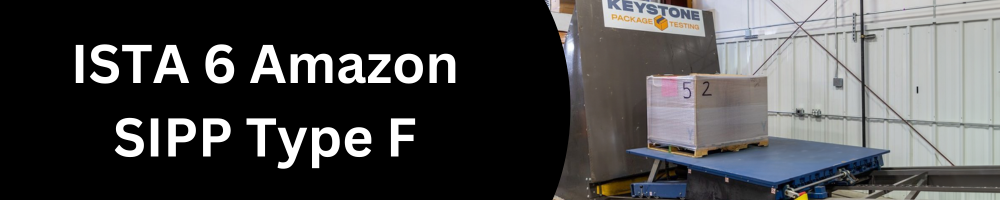
Amazon SIPP (Ships in Product Packaging) Type F Package Integrity Testing
The Amazon Package Test Type F is a standard developed for pallet testing, employing the pallet handling method. This standard, a collaboration between Amazon and the International Safe Transit Authority (ISTA), is officially known as ISTA-6 Type F.
Type F is a component of Amazon’s SIPP (Ships In Product Packaging) packaging program. SIPP packages are not shipped in an Amazon box (a practice termed over-boxing), but rather in packaging provided by the seller or vendor. The key requirement is that the pallet must endure the shipping environment of the entire Amazon distribution system.
ISTA 6 SIPP Type F Verification Process
Pallets face various environmental conditions, beginning at the vendor or seller’s location, transferring to the Amazon Fulfillment Center, and culminating at the customer’s location. Amazon demands packaging materials that adequately protect the product.
Packaging must meet frustration-free standards: easy to open, with no prep requirements, designed to reduce waste, and minimizing weight and dimensions to avoid overpacking.
Amazon SIPP Testing Overview
Amazon’s APASS (Amazon Packaging Support and Supplier) program mandates certification for packaging test labs, focusing on compliance with Amazon and SIPP (Ships in Product Packaging) standards. The need for APASS certification arises in several instances:
- Introducing a new product or package on Amazon.
- Making design changes to an existing product.
- Updating packaging due to changes in Amazon’s requirements.
- Addressing shipment damage issues noted by Amazon.
Undergoing APASS-certified testing offers multiple advantages, including accelerated product launches, reduced distribution costs, minimized damages, and enhanced customer satisfaction. This certification, aligned with ISTA standards, ensures packaging meets Amazon’s and SIPP’s rigorous criteria, promoting a better marketplace experience.
Unacceptable Packages
Amazon evaluates acceptable packages based on their performance in tests.
Certain package designs are deemed unacceptable, including those with non-taped, 123 or auto bottom boxes, protruding tuck flaps, tabs, and handles.
Tuck flaps that stick out are also rejected.
Cut outs, where the packaging partially or fully exposes products, are prohibited.
The use of plastic bags and other coverings is not allowed. Packaging that deforms due to insufficient strength will result in failure, and boxes that lack six sides are not permitted.
Amazon SIPP Type F Pass/Fail Criteria
Before testing starts, a collaborative effort sets the standards. Amazon sellers, vendors, shippers, and stakeholders come together. They define what counts as product damage. They also decide the acceptable condition for products and packaging after testing. Plus, they set the damage tolerance levels. These standards align with Amazon’s ISTA (International Safe Transit Association) guidelines.
Sellers and vendors on Amazon play a key role. They actively participate in this important phase. Package verification is a crucial step. For sellers, this happens through Seller Central. For vendors, it’s a required part of enrollment. This process helps prevent transit damage. It also aims to improve customer satisfaction.
By setting clear criteria, Amazon ensures product quality. It meets the highest standards for packaging integrity and durability. This approach supports Amazon’s commitment to quality and sustainability across its delivery network.
Overview of the ISTA-6 Type F Test Plan
The scope of testing for Amazon Type F packages differs due to the use of the pallet handling method. Below is the test sequence for Amazon fulfillment packaging.
Type F – LTL Delivery of Individual Palletized Packaged-Products | ||||
| Sequence Number | Test Category | Test Type | Test Level | Remarks |
| 1 | Atmospheric Preconditioning TEST BLOCK 1 | Temperature and Humidity | Lab ambient, 12 hours | Required |
| 2 | Atmospheric Conditioning TEST BLOCK 1 | Controlled Temperature and Humidity | Temperature and humidity chosen from chart | Optional |
| 3 | Shock TEST BLOCK 3 | Tip/Tip Over | Use a 22 degree tip angle | Required for packages ≥48 in. (1.2 m) tall and any one base dimension < ½ the height; or for packages ≥ 30 in. (760 mm) tall and with a center of gravity vertical location > ½ the package height |
| 4 | Shock TEST BLOCK 5 | Rotational FLAT Drop | 9 in (230 mm) | Required |
| 5 | Shock TEST BLOCK 6 | Rotational EDGE Drop | 9 in (230 mm) | Required |
| 6 | Shock TEST BLOCK 7 | Rotational CORNER Drop | 9 in (230 mm) | Required |
| 7 | Shock TEST BLOCK 8 | Inclined or Horizontal Impact | 48 in/sec (4 ft/sec) (1.2 m/sec) impact velocity or velocity change | Required |
| 8 | Compression, Vertical TEST BLOCK 9 | Top-to-Bottom Pallet on top | Calculated from formula | Required, Machine or weights and load spreader |
| 9 | Shock TEST BLOCK 11 | Fork Lift Simulation | Flat Push and Rotate tests, Elevated Push and Pull tests | Required |
| 10 | Vertical Vibration TEST BLOCK 14 | Random With Top Load | Overall Grms level of 0.54 | Required |
| 11 | Shock TEST BLOCK 17 | Rotational FLAT Drop | 9 in (230 mm) | Required |
| 12 | Shock TEST BLOCK 18 | Rotational EDGE Drop | 9 in (230 mm) | Required |
| 13 | Shock TEST BLOCK 19 | Rotational CORNER Drop | 9 in (230 mm) | Required |
| 14 | Shock TEST BLOCK 20 | Inclined or Horizontal Impact | 48 in/sec (4 ft/sec) (1.2 m/sec) impacts or 3 in. (76 mm) drops | Required |
| 15 | Shock TEST BLOCK 24 | Concentrated Edge Impact | Hazard box dropped 16 in (410 mm) | Required for Flat Packages Only |
Start the Package Testing Process
Keystone Compliance can assist you in achieving the benefits of a certified package. Whether you are certain of your needs or need guidance, we are here to help. We understand Amazon.com package testing requirements and know that ASINs can be grouped to reduce testing.
As an Amazon APASS package testing lab, Keystone Compliance assists numerous companies annually with their compliance testing needs. Request a quote to find out about our short lead times, efficient report writing, and volume discounts. We look forward to partnering with you to certify your packages efficiently.
Let’s get started!
For additional resources on SIPP testing, including a free test-type calculator to help determine the most suitable test type for your product, visit our APASS Lab website. Our goal is to assist you in selecting the perfect test to guarantee your product arrives in excellent condition, providing a positive unboxing experience for your customers.
For more information on SIPP testing, follow the corresponding links: